TAGLINES
FIGHTING AIDS ONE BOOK AT A TIME

Housing Works
Bookstore Café
IT’S A LONG STORY. TELL IT WELL.

Fairleigh Dickinson University
MFA in Creative Writing
OH GROW UP
THE ICE CREAM GETS BETTER.

Case Study: Ad for liquor-laced ice cream
SALTINES …THE ORIGINAL CRACKER

Case Study: Ad for Saltines Anniversary Campaign
AD COPY

TLR AD 2016
Reader: You know our magazine is doing something different, something you can’t find in commercial publishing. We’re not afraid of literature, hybrid genres, foreign fiction, long poems, novellas. In these pages, bold new voices appear alongside established luminaries, and the results are exciting, vibrant, literary. Be brave. Read adventurously. TLR

CASE STUDY: PATAGONIA WORN WEAR CAMPAIGN
Hey, it’s been a while. How’s that fleece working out? Need any repairs? Or, maybe you’re getting a little bored of that color by now? We could trade in for a new color? Entirely up to you.
COVER LINES
A selection of cover lines from past TLR issues
FIGHT: WE STAND OUR GROUND IN THESE PAGES, LET WORDS CUT, BUILD FORTRESSES FROM LANGUAGE, FORGE ARMOR WITH EVERY LINE. N FEAR. OUR WRITERS ARE WARRIORS. YOU RUN, WE’LL FIGHT.

WINTER 2016. COVER ARTIST: FAZAL SHEIKH
CRY BABY IS THE ISSUE IN WHICH WE CONSIDER WHETHER LONELINESS IS BAD, AND WHETHER LOVE HURTS, AND WHEN EXPECTATIONS ARE CRUSHED, AND WHY HAPPY ENDINGS ALWAYS LEAD TO TEARS.
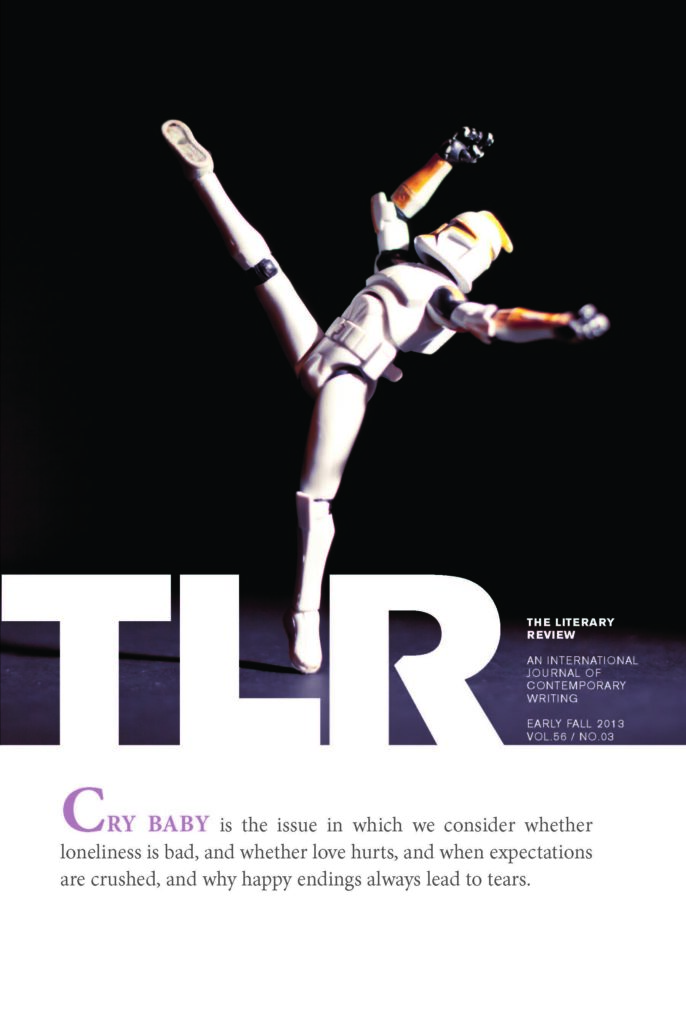
FALL 2013. COVER ARTIST: REBECCA ASHLEY “CORPS DE CLONE”
FEVERISH: WHEN PASSIONS RUN HOT. POEMS BOIL. THIS MAGAZINE RAISES TEMPERATURES. WORDS FAIL, WORDS FLAIL. THE STORIES NEED NO THERMOMETER. TAKE TWO AND READ IN THE MORNING.

SPRING 2019. COVER ARTIST: MARJAN LAAPER
SCENESTER: EVERYTHING IS HAPPENING RIGHT HERE RIGHT NOW
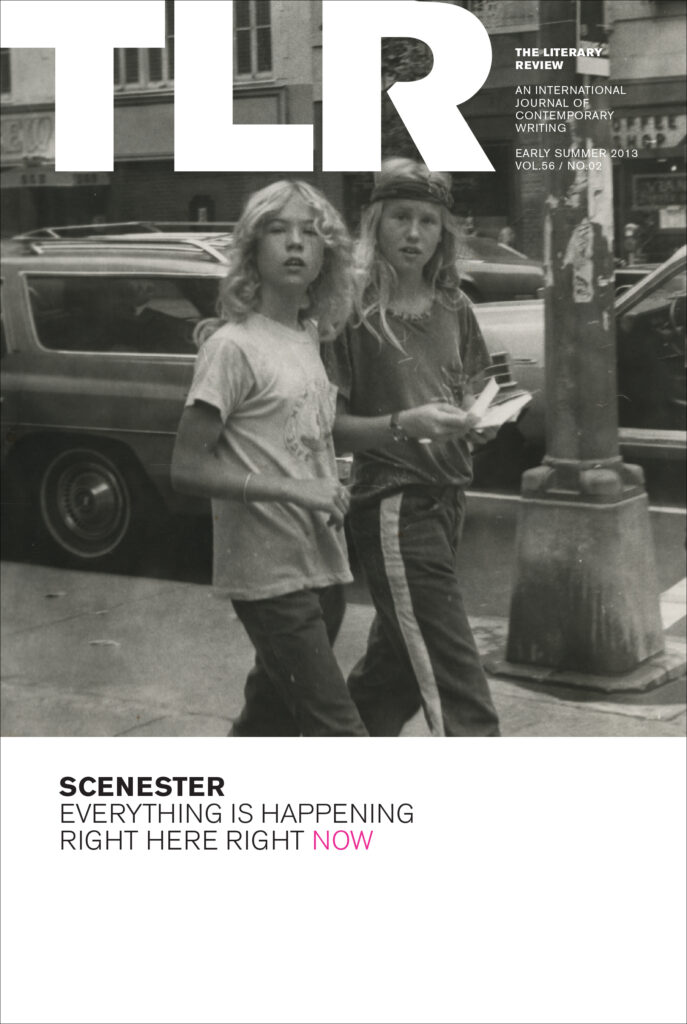
SUMMER 2013.
ONE SHEETER
How The Literary Review Supports the University
Internal One-Sheeter
Overview: The Literary Review publishes a professional, internationally well-regarded literary journal that enhances the public profile of Fairleigh Dickinson University as an institution of excellence in the fine arts and humanities, exemplifies FDU’s deep and historical commitment to supporting literature in American Culture, recruits undergraduate and graduate students to the Creative Writing programs, and serves the student population of FDU with professional experience in the broadest aspects of their publishing career goals.
The Numbers:
- TLR publishes over 500 pages of fiction, poetry, and prose every year
- TLR’s international print circulation is 4,000 per issue, including epubs and databases
- TLR receives an average of over 2,100 submissions every year, of which we accept less than 3% for publication
- TLR’s e-newsletter, goes out to nearly 6,000 subscribed readers each month, with an impressive open rate of 25%
- The TLR website averages 1,700 unique pageviews every day
- The Literary Review on Facebook has more than 4,800 “likes” | The TLR Twitter account (@TLR_tweets) has nearly 2,464 followers | TLR on Instagram has 2,791 followers
- Theliteraryreview.org directs 100s of people to both the university website (fdu.edu) and the MFA program website (writingfdu.org) each yearTLR’s international print circulation is 4,000 per issue, including epubs and databases
Institutional Value: TLR hires 2 to 5 undergraduate for-credit interns per semester. It is the only on-campus creative writing internship that provides professional publishing experience. Through graduate fellowships, TLR hires two current MFA students to work in editorial positions on the masthead. This high-level internship significantly increases MFA student hireability. Over the past two years, surveys of current MFA students revealed that in a majority of cases TLR was one of the deciding factors that brought them to FDU. At any given time TLR has between 10-20 editorial readers from the extended FDU creative writing community. The FDU MFA program is one of only a handful of low-residency programs in the country that is affiliated with a professional literary magazine.
Community Value: The Literary Review was established in 1957 by university founder, Peter Sammartino. The magazine has published an impressive array of literary legends, many of them Nobel laureates and Pulitzer Prize winners, bringing recognition to the university and raising our profile in the academic community. Our senior editors have national profiles, appearing widely and publishing in premier publications like The New York Times, The New Yorker, and NPR. TLR’s editorial board is comprised of nationally acclaimed poets, novelists, and professors.
In the last few years, TLR has had four poems selected for inclusion in Best American Poetry, and two essays selected for Best American Essays, as well as a number of honorable mentions across the Best American series, one the most important recognitions of a magazine’s excellence. TLR was a finalist for the 2019 Firecracker award for general excellence, and an Amazon Literary Partner the same year. TLR has won three NEA grants to support its publication.
Mission: The mission of The Literary Review (TLR) is to publish the best new fiction, poetry, and prose from a diverse community of international writers and translators, both emerging and established, whose commonality is literary quality and an urgency of voice and artistic conviction. Our editorial standard is to read with an open, discerning mind, cultivate emerging editors, and to publish carefully and vigorously. But it is the genuine community of readers, writers, and publishers that distinguishes TLR and defines how we connect our writers to readers and to each other.
EDITORS LETTERS

The Rogue Idea
WINTER 2011
Selecting a theme for a given issue of TLR is both exhilarating and completely imprecise. From the outset, we wanted to broaden the definition of “theme” so that it was inclusive while remaining definitive—the idea being to suggest at least one context in which each individual contribution could be read and appreciated. As editors and readers, that has allowed us to open our minds to work we might otherwise have overlooked or simply understood differently, because we’re able to read through an interpretive filter that amplifies rather than narrows. At the same time, contributors aren’t constrained to produce work engineered to adhere to strict guidelines—the guidelines are really rather a provocation. Which has been a good balance. But not, as I suggested from the outset, without its moments of head-scratching confusion, particularly when the theme, as in the case of this issue, is in itself a kind of fundamental abstraction. “The Rogue Idea” began as a discussion, over lunch, about the art of book reviewing and ended up, here in these pages, on some idiomatic metaphysical spectrum, spanning practical jokes and fiction-writing workshops, police sketches, and the geography of God. What is a “rogue idea”? Do we recognize it as such (new, bizarre, innovative, dangerous) in the moment that it arrives, seemingly fully formed, on our horizon? Do ideas that seem to diverge from conventional wisdom sometimes reveal themselves to be the essence of convention? Are other ideas, received at the time of their introduction as if covered in cobwebs, like Miss Havisham’s wedding cake, actually radical departures from the norm? Are those departures intrinsic, even essential to the norm? Is our cultural wholeness dependent on the anarchic twist? Or, tacking toward the lighter side, is an irregular, irreverent viewpoint precisely the gust of fresh air needed to blow away the cobwebs? As a model modern neurotic with a predilection for obsessive (as in, inescapably circular) thinking, I idealize the rogue idea. It represents heroic clarity and unselfconscious aesthetic determination, a pure, organic phenomenon: Halley’s comet slicing in an instant through a muddy midwinter night sky.

Contents May Shift
SPRING 2020
Today it seems absurd to say things like “the way things are,” or “these extraordinary times,” or “in times like these.” There aren’t really “times like these,” there is rather this time, Covid time, which redefines itself from one day to the next. Covid time trumps time generally. Covid time reveals the thin patches and engraves the oddest things. As I write, New York City is being battered by a hailstorm, and now there’s sun.
It might surprise you to know that our theme, Contents May Shift, has been in the works for a year. We were thinking of it first in terms of those pragmatic alerts on cereal boxes. Then we were delighted by the idea that our theme would accommodate anything, as long as it
surprised. And then, as this long spring settled into global upheaval, we thought “how clever of us.”
But we didn’t really know in January what the next six months would bring. We couldn’t have.
TLR is, like the world, for the moment transformed. Perhaps the only thing that hasn’t shifted at this point, are our contents. The writing that makes up Contents May Shift is beautiful, is surprising, and is outside of Covid time in so many respects. J. Robert Lennon writes of overgrown rose bushes and his grandmother’s funeral. Mira Rosenthal translates a lilting Polish poem about marriage and murder. Brandon Taylor is disturbing and enchanting in his story about desire and isolation (that brutal paradigm). Which must be on people’s minds, because Stephanie Bernhard has a totally different take on the same subject. There are
kidnappers and magic boats, dystopian nurses, and drunks. Everything you’d expect from TLR… in a slightly different package. Because contents may shift and because, you know, Covid.
For the near future, we’re going virtual. The next few issues of TLR will be delivered online as web series, starting with this one. The work is free to all. We hope you read and enjoy and share.
Happy reading,
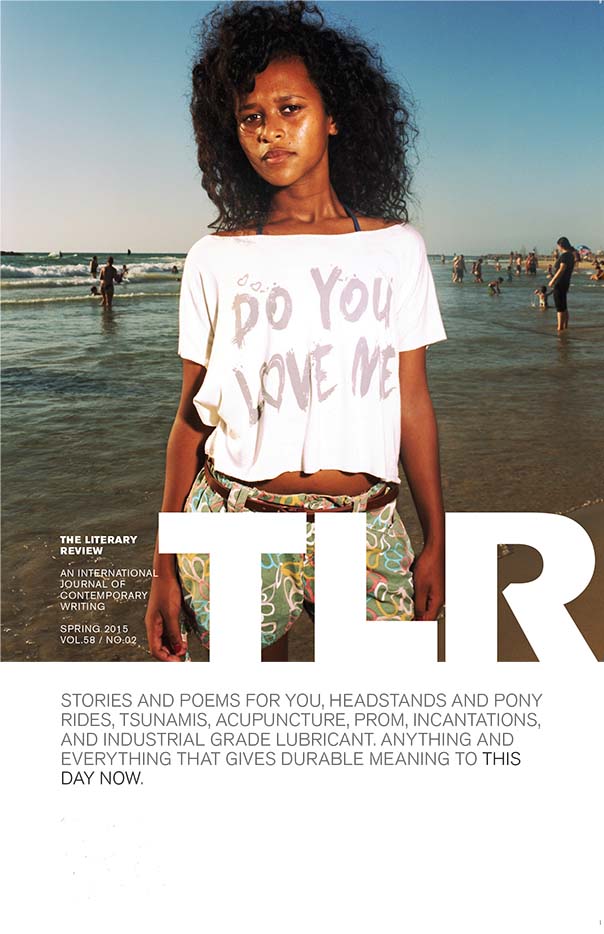
Do You Love Me?
SPRING 2015
The stories and poems collected here are largely about perspective, specifically the shifting perspectives of age. Our governing principle as we chose work for this issue was youth versus age—or experience. The result is that everything you’ll read here is on the same essential spectrum of concerns, but it’s a spectrum without a middle—without all of us people in the middle between youth and age. It’s unexpectedly refreshing. When you think about it, we (all of us middle people) usually dominate the narrative. Progeny of Dante perhaps: Midway through the journey of my life / I came across a dark forest. . . . Leave the Poet in the dark forest—just for a while. He’s not going anywhere.
We always had in mind, naturally, that youth itself is a kind of precocious brilliance: the enthusiasm, naivété, the inspired heedlessness of not knowing better, the exquisite wonderment of seeing things for the first time. My children once thought that windshield wipers were the most extraordinary feature on our car, and surely the quality that set it above all other cars on the road. Only an adult could have recognized how gorgeous it would be to go around thinking of windshield wipers as a miracle. Art teachers often try to coax their pupils toward insight by getting them to see things again like a child, to recapture wonder, and then synthesize it—as only a grownup could. “To see a World in a Grain of Sand / And a Heaven in a Wild Flower.”
On the other end of the spectrum, there is the perspective of the very grown up. As you move into your later years, all of the painful reconciliation of middle age folds into a functional understanding of the world, something that you can live with—and die with. How much more you know, how you narrow your scope and become more efficient in your needs and your expressions.
My grandmother, much to everyone’s dismay, went deaf in her old age. She couldn’t hear a word—unless she was talking to children or her priest. She was an excellent reader of lips, my father tells me, but if she didn’t want to talk she just turned in the other direction. Narrow but efficient, and unequivocal.
I have a very dear friend, deep into her eighties, who only ever refers to sex as fucking. And sometimes in conversation you can see that she really likes the way the word sounds because she’ll figure out a way to repeat it just a few more times: fuck, fuck, fuck. She’s not being grumpy. She’s a clear-eyed minimalist and a spade is a spade.
The other day I sent my father a short interview I’d come across that Igor Stravinsky gave when he was about seventy-four, in which he discusses music and the church. It’s a dense treastise full of declarative sentences: “Religious music without religion is almost always vulgar.” It’s the expression of comprehension and the discarding of what’s extraneous, broken, or full of static. Over forty years after he’d detonated classical music into the modern period with The Rite of Spring, the elderly composer rails against the hollowness of secularism. The interviewer asks: “Must one be a believer to compose in these forms?” Stravinsky answers, “Certainly, and not merely a believer in ‘symbolic figures,’ but in the person of the Lord, the Person of the Devil, and the Miracles of the Church.”
My father, a musician and former seminarian, wrote back to me a single line: “I must have read this at some point but it is more meaningful now.” Now he is Stravinsky’s age as an old man. At some point though my father was a young man— as Stravinsky was when people ran from auditoriums, clutching their ears in horror at polyphonic noise he’d composed and called music.
The detonation is less important than what it revealed.
The remarkable picture on our cover is by the photographer Gillian Laub. When I look at that last line above, I can’t help but think of her work. Most explicitly her first monograph Testimony (2008), an unflinching collection of portraits of victims of violence in the Middle East—not photographs of war, but of its aftermath. More recently, Laub traveled to Georgia to photograph a racially segregated prom. The portfolio, which published in the New York Times, drew so much negative attention that the small town merged its two proms. Laub returned to document the new, improved event and discovered a bramble of racial dynamics far more complicated, and more embedded than what she’d thought she’d seen when she first reported the story. The documentary film she made about her experience, Southern Rites (2015), demonstrates perhaps most profoundly the inadequacy of language, and especially the inadequacy of conventional ideas of storytelling when discussing race in America. The story of a prom was an expression, not necessarily a story, and the integration of the prom was hardly a neat resolution, let alone a happy ending. 6
Throughout her work, whether photographing teenagers in the American South, girl soldiers in the Middle East, her exotic Westchester family, or beachgoers in Tel Aviv—as on our cover—Laub’s images portray the complexity of surfaces and the challenge of subtext, all visual not verbal. She pushes a golden light over subjects we’d rather turn away from, teasing out highlights, sheens and angles. Then she defies you to describe any of her subjects as simply pretty. Because the image captured in the frame is only the threshold of a story, and stories, and things that can’t be neatly tied up, and things we shouldn’t necessarily turn away from.
We chose this theme for our spring issue because we wanted to explore the most unruly boundaries of literature, the emotionally hyperreal. Overheated language and inflamed ideas; the way form tames chaos or mimics it. When I think of feverish writing, I think of Simone Weil, desperately trying to figure out God’s role in suffering in absolute ethical terms—her urgency fueled by migraines, frustration, hunger, longing, and war. Hannah Arendt, Weil’s contemporary and philosophical equal, toiled away at similar questions but had not an iota of fever in her. In his heyday, Tom Robbins was feverish and hallucinating. Virginia Woolf was never feverish, but could write fever like nobody. Janis Joplin and Aretha Franklin performed feverishly. Elton John and Tina Turner perform for the feverish. Paul McCartney and James Taylor are both refrigerated in their brilliance, never hot . . . The implied designations of this theme are more fun than video games, and yet possibly no more consequential than a colorfully suggestive adjective. What makes something feverish, or not? On a scale of feverish, how will you rate the stories and poems that follow?
ANNUAL REPORT
The Literary Review | Fairleigh Dickinson University
2016–17 Year-End Report: TLR
Contents
- Introduction & Mission Statement
- Overview Of This Past Year
- New Team Members & Masthead
- News, Honors & Press Website
- Social Media, Newsletter, and Circulation Collaborating with Academic Programming at FDU Intern Experiences: Testimonials
- What We Published This Year, By Issue:
- Big Blue Whale
- Heaven
- I Live Here
Introduction
Fairleigh Dickinson University has been publishing The Literary Review (also known as “TLR”) since Peter Sammartino founded the quarterly journal with Charles Angoff and Clarence Decker in 1957. The inaugural issue included the following mission statement: The Literary Review “seeks to encourage literary excellence and its appreciation by a wider audience and to further cultural exchange among the peoples of the world. It is hospitable to young writers of promise and to those whose reputation is established. Poetry, fiction, sketches, plays, imaginative essays concerning literature—all are welcome from those who have something of value to say and are capable of saying that something well.” True to its promise, that first issue included original work by great American writers E.E. Cummings, Langston Hughes, and William Carlos Williams. Sixty years on and 10,250 individual pieces later, we reiterate our promise to publish the best new fiction, poetry, and prose from a broad community of international writers and translators, both emerging and established whose distinguishing commonality is literary quality and an urgency of voice and artistic conviction. This past year has proved to be an extraordinary demonstration of TLR’s ongoing commitment and achievement in the global world of literature, as well as a vibrant part of the FDU arts community.
Mission Statement
The Literary Review publishes a professional, well-regarded international literary journal that enhances the public profile of Fairleigh Dickinson University as an institution of excellence in the fine arts and humanities, exemplifies FDU’s deep and historical commitment to supporting world literature in American culture, recruits undergraduate and graduate students to the Creative Writing programs, and serves the student population of FDU with professional experience in the broadest aspects of their publishing career goals. One of the nation’s oldest continually publishing literary magazines since 1957, The Literary Review also represents one of FDU’s most robust legacy endeavors.
TLR doesn’t just print. TLR engages. TLR thinks with me. TLR opens my mind. TLR opens my heart.
— Katherine Willingham, poetry contributor, TLR: “Uncle”
Overview
This past year, we’ve published amazing new work from writers all over the globe, and collaborated extensively with emerging young writers from FDU’s Creative Writing programs who are just starting out on their publishing careers. We’ve published four issues, representing almost a thousand pages of new writing and writers from over sixteen different countries (not including the U.S.). We’ve created and staffed a new editorship, dedicated to social media outreach with fantastic results. We’ve converted to an upgraded circulation database, and continue our circulation strategic plan for subscription management and growth. We’ve brought on new editorial staff, each new member recruited from amongst our phenomenal FDU alumni community. We’ve brought TLR to conferences, festivals, and workshops; built new distribution relationships with independent bookstores, and distributors. We’ve piloted a new, expanded undergraduate internship program that makes our already popular internship even more valuable to graduating Creative Writing majors.
TLR’s Unit Objectives
- Recruitment to FDU’s creative writing programs
- Providing graduate students with professional opportunities in literary publishing
- Providing undergraduate students with professional experience
- Engaging and cultivating the creative writing FDU alumni community
- Increase TLR name recognition and build the publication reputation of TLR and an FDU education in the literary community
- Reach more readers through broader circulation, website, and digitization
- Publish a high-quality international literary journal people want to read
[IMAGE: Gloria Beth Amodeo (FDU, BA 2009), former TLR Intern and then Online Editor and Julia Ann Van Middlesworth (FDU MFA 2011) working at the TLR table at the Brooklyn Book Festival]
Team Members
NEW TEAM MEMBERS
LISA VOLTOLINA GRGAS,ASSISTANT PROSE EDITOR
Lisa Voltolina Grgas MS, CCRP is a SoCRA-certified Institutional Review Board (IRB) analyst with over nine years experience as a clinical researcher at Oregon Health & Science University (OHSU) in Portland, OR. Recent research has appeared in The Journal of AutismSpectrum Disorders and Toxins. In addition to her clinical research, Lisa is a poetry reader at TinHouse. Before relocating to Portland, Lisa was the Executive Assistant to Lisa Gallagher, then the Vice President and Publisher for William Morrow, Harper Collins Book Publishers, and completed an internship at Donadio and Olson Literary Agency in NYC. She has also read for Tiferet Journal, Bellevue Literary Review, and InPosseReview.Her creative work has most recently appeared in Web Del Sol Review of Books, and Fractal. Previously, Lisa served as TLR Assistant Poetry Editor, and in August will be promoted to Associate Poetry Editor. (FDU BA ’06 / FDU MFA ’17)
JESSICA MARTINEZ, TLR SHARES EDITOR
Jessica Martinez is a writer from Queens, New York. In addition to her work with TLR, she has just joined the staff of Serving House Books as the financial manager and an associate editor. Jessica has spent most of the last nine years teaching preschool at Discovery Programs in Manhattan. She currently lives in Honesdale, Pennsylvania. (FDU MFA ’17)
AMINAH ABUTAYEB, ASSISTANT POETRY EDITOR
Certified from the University of Cambridge in English Language Teaching to Adults (CELTA), Aminah also teaches English to grades five through eleven at Scholars and Leaders Academy in Clifton, New Jersey. She is also at the Writing Center at William Paterson University, where she tutors undergraduate and graduate students. Aminah earned her Bachelor’s degree in English Writing with a minor in Philosophy in 2015 from WPU. Her poetry has been published in Philadelphia Stories and Common Ground Review. (FDU MFA ’17)
LETISIA CRUZ, TLR SHARES EDITOR
Letisia Cruz is a Cuban-American writer and artist living in Miami, Florida. Her writing and artwork have recently appeared in Ninth Letter, The Acentos Review, Gulf Stream, and Moko Caribbean Arts and Letters, and her chapbook Chonga Nation was selected as a finalist in the 2016 Gazing Grain Press Poetry Chapbook Contest. She serves as Resident Artist at Petite Hound Press and earns a living as a marketing coordinator for a local engineering firm. (FDU MFA ’14)
PROMOTIONS
Heather Lang (FDU MFA ’14 / ’17), formerly Associate Poetry Editor and Online Managing Editor, will be joining Jessie Vail Aufiery (FDU MFA ’13) as World Literature Editor.
MASTHEAD
Editor Minna Zallman Proctor (MFA faculty)
Poetry Editors Craig Morgan Teicher and Michael Morse
Fiction EditorJustin Taylor (MFA visiting faculty)
Editors-at-Large Renée Ashley (MFA faculty) and René Steinke (FDU faculty)
Managing Editor Kate Munning
Editorial Coordinator Louise Dell-Bene Stahl (FDU BA 1987)
World Literature Editors Jessie Vail Aufiery (MFA ’13) and Heather Lang (MFA ’14/17)
Books Editor Cory Johnston (MFA ’14)
Associate Editors Nina Ball-Pesut (MFA), Ryan Romine (MFA ’12), Tim Waldron (MFA ’14)
Online Editors / TLR Shares Letisia Cruz (FDU MFA ’14) and Jessica Martinez (MFA ’14)
Editor Emeritus Walter Cummins
Assistant Editors Aminah Abutayeb (MFA), Briana McDonald (FDU MFA), Amanda Ramirez (BA/MFA)
Editorial Interns (FDU undergraduates): Danielle MacConnell, Gabriella Shriner, Christina Sobszak, Maiasia Grimes, Matthew College, Zachary Heffner, Katrina Elwertowski
[IMAGE: World Literature Editor, Jessie Vail Aufiery and TLR Shares Editor Letisia Cruz at the O, Miami Poetry Festival 2017. Courtesy Miami Daily News]
Readers: Mariella Aponte (MFA), Anthony Ausiello (MFA), Hayden Bergman (MFA), Robin Calcagnetti, Natalie Cannon (MFA), Cara Cavall, T. Nicole Cirone (MFA), Flower Conroy (MFA), Andrea Cox (MFA), Kimberly Coyle (MFA), Ceyda Demirbulakli (BA/MFA), Maria Denoia, Patty Keefe Durso (FDU faculty/MFA), Abby Eckert (MFA), Amelia Fisher (BA), Rogan Kelly (MFA), P. Joshua Laskey (MFA), Lars Lichtenfeld (MFA), Tammara Lindsay-Scrivens, Danielle MacConnell (BA), Isabel Mader (MFA), Abby Maguire (MFA), Marina Marcello (MFA), Chad Meadows (MFA), Nicole Melleby (MFA), Adrienn Mendonca-Jones (MFA), May Nasr (MFA), Maxine Patroni, Maria Poulatha, Cassie Pruyn, Colleen Quinn (MFA), Glenn Schaefer (MFA), Rob Sobel (MFA), Dan Stockman (MFA), Dana Stokes (MFA), Ian Stone (MFA), Ginger Thomason (MFA), Paul-Victor Winters, Anne Harding Woodworth (MFA)
News, Honors, and Press
IN THE NEWS
“Studio 360” (NPR/PRI) with Kurt Andersen interviewed TLR contributor Osama Alomar and cited The Literary Review in the on-air introduction. TLR’S FIGHT issue received a four-star review from The Review Review (TLR: Winter 2016). Exchange ad for TLR posted in BOMB magazine (circulation 32,000)
EVENTS
TLR Editors Launch Party at Housing Works Bookstore Café, August 2016, featured Rachel Sherman, Craig Morgan Teicher, Justin Taylor, and Renée Ashley. No,You Tell It!—a switched up reading series run by MFA ‘14 alum Kelly Jean Fitzsimmons—was selected to appear at the Associated Writers Conference in Washington DC this past March. Featured readers included TLR Editors Minna Zallman Proctor, Heather Lang, Jessie Vail Aufiery. Proctor also appeared in another panel about website redesign with TLR website designer Bud Parr. The AWP Conference had over 12,000 attendees. TLR created a unique letterpress art-poem poster featuring the work of MFA faculty H.L.Hix, ran a successful table staffed by most of TLR’s editorial staff and MFA alum, and collected autographs and testimonials from over 95 contributors. In October, TLR teamed up with Helen A Literary Magazine for Viva Las Vegas!, a reading/launch event at The Writer’s Block in Las Vegas. We exhibited at both the Queens and Brooklyn Book Festivals this past year.
HIGHLIGHT NEWS ABOUT EDITORS AND CONTRIBUTORS
Editor Minna Zallman Proctor has three forthcoming publications: Translation from Italian of These Possible Lives by Fleur Jaeggy (New Directions, July 2017), from which she read at The Gansevoort (NYC) with Susan Bernofsky (TLR contributor and guest MFA faculty) for New Directions. Proctor also appeared at Book Culture (NYC) in March for New Directions to celebrate the bookstore’s 20th anniversary. Proctor is the co-writer with Bethany Beardslee on I Sang the Unsingable: My Life in 20th Century Music (University of Rochester Press, September 2017). Proctor will be launching a new collection of original essays in September 2017 entitled Landslide. Proctor is a judge in the category of Best Literary Magazine in the CLMP Firecracker Awards 2017.
Poetry Editor Craig Morgan Teicher published a new collection of poetry, The Trembling Answers (BOA Editions, March 2017). His poetry was also featured this spring on the Academy of American Poets website. He discussed small presses and the poetry business with FDU creative writing students in April and with TLR contributor Rachel Zucker on her podcast, Commonplace. Teicher’s short story “The Child Runs Away” was featured on Agni online.
Fiction Editor Justin Taylor published a feature piece in Harper’sMagazine on the Icelandic writer Halldór Laxness and a review of Joy Williams new book Ninety-Nine Stories of God in the NewYork Times Book Review. Taylor was the Booth Tarkington Writer in Residence at Butler University this past year. This summer, Taylor and poetry editor Michael Morse will present TLR to students at the Iowa Summer Writing Festival.
Editor Emeritus Walter Cummins had a piece anthologized in the collection Aging: An Apprenticeship (Red Notebook Press, April 2017). Assistant Editor Briana MacDonald had stories published in Glassworks Magazine and in The Cardiff Review. Assistant Editor Amanda Ramirez was hired as an Assistant Editor at Simon & Schuster. TLR Books Editor, Cory Johnston, appeared in New York at a Catapult masterclass, speaking about the ins and outs of getting published. TLR Online Managing Editor Heather Lang was chosen by the readers of Desert Companion as Las Vegas’ Best Local Writer or Poet, and was published several times on her local NPR Station (on air and online).
TLR Contributor Tina Cane, who appeared at our summer “Big Blue Whale” launch party at Housing Works Bookstore Café, was named Poet Laureate of Rhode Island. Contributor Sally Wen Mao was featured on Poem of the Week, alongside TLR reviewer Alex Crowley‘s piece about her book. Former TLR assistant editor Elizabeth Jaeger’s short story “Burn” was published by Inside The Bell Jar. Poetry Daily (circulation: 110,000) republished Melissa Stein’s poem “Zero” (TLR: Summer 2016). Verse Daily republished TLR poems from Melissa Stein, Gretchen Marquette, and Mira Rosenthal. Last year’s feature on William Bronk by Daniel Wolff was discussed in a Paris Review Daily.
Best American: Brenda Shaughnessey’s “But I’m the Only One” (TLR: Fall 2014) appeared in BestAmerican Poetry 2016. Susan Thornton’s “Border Crossing” (TLR Summer 2015) appeared in Best American Mystery Stories 2016. Nick White’s story, “The Lovers,” (TLR: Fall 2015) was an honorable mention in Best American Stories, and both Chris Arthur (TLR: Spring 2015) and Peter LaSalle (TLR: Fall 2015) were honorable mentions in Best American Essays 2016.
[IMAGE: Rachel Sherman, Craig Morgan Teicher, Tina Cane, Justin Taylor, Renee Ashley at the TLR Summer launch event in New York City]
Spring of 2013, we launched a totally redesigned TLR website. We’ve been working since then with Bud Parr of Sonnet Media, an expert developer of web design for literary publishers, to perfect a contemporary, responsive website that focuses on our primary activities: publishing great writing, selling subscriptions to TLR, accepting submissions, attracting writers to creative writing programs at FDU, and creating a literary hub for an expanding network of readers, writers, and fellow publishers. The website was designed to publish each day only full text literature, from the TLR archives and from other literary magazines (online and print) so that curious readers have a place to go to read. Once a week we also publish reviews of new books of poetry, literary translations, and work from smaller independent presses. Our primarily text format, as well as our community driven republishing schedule makes our site unique among literary magazines. The Community of Literary Magazines and Small Presses, an independent advocacy nonprofit, gave our website its highest rating in an annual review and included TLR in its 2017 AWP panel on Redesigning Your Literary Website.
average monthly visits: 5,500
SocialMedia,Newsletter,and Submissions
READ MORE: Our monthly newsletter, Read More, goes out to 6,000 subscribers and has a 25% average open rate, which is astronomical for an email newsletter. Each newsletter features just one poem or short story, full text, from a recent issue. It is a simple approach to expanding the reach of our publication, but we have found it to be one of our most successful projects.
Social Media: Our Facebook page has 3,800 likes; and Twitter has 1,700 followers. We update our social media daily with announcements about contributor events and publications, posts from the TLR website, news about members of our editorial board, invitations to TLR events, and the publication of a new issue. Social media is a primary driver to the TLR website, second only to native word searches.
Submissions: The heart of our readership is made up of emerging writers and aspiring contributors. We have received 1,800 unsolicited submissions this year.About 10% of the work we publish is selected from these submissions. We pride ourselves on publishing a high rate of extraordinary new writers from the unsolicited submissions, and consider that profile to be a recognized niche in the literary marketplace.
Traffic: 30% of our traffic is referred from other literary websites. Here are some of the sites that link to ours: Web Del Sol, New Pages, Lithub, World Newspapers, Poets and Writers, Tin House, New Pages, The Review Review, National Book Critics Circle
Collaborating With Academic Programming at FDU
One of TLR’s ongoing objectives is to collaborate with the Creative Writing Department to prepare the students for a professional life in the literary marketplace, and to cultivate a vibrant, invested alumni community. For the MFA students, TLR represents a unique opportunity to read for, intern at, and get editorial fellowships with an international literary magazine. This year:
- There are over 50 current and former FDU undergraduate and graduate students on the masthead of our latest issue.
- Seven undergraduate students had semester long, for-credit internships in the TLR office.
- Two talented MFA students were granted second-year GA positions to work as Assistant Editors on the TLR Masthead.
- Two more MFA students were hired as paid interns at the Assistant Editor level
- A Dual-Track third year MFA student was hired as a paid intern at a Managing Editor level
- TLR gave a masterclass on publishing and submitting to literary journals at the MFA summer residency (August 2016). A similar masterclass was presented to the undergraduate publishing class in Spring 2017
- TLR Editor, Minna Proctor, collaborated intensely with MFA director, René Steinke, on the marketing and advertising strategy for MFA program recruitment, and TLR internships have been highlighted in the undergraduate program’s recruitment campaign.
- Proctor has also been involved in the faculty committee for the proposed FDU School of the Arts. She is currently collaborating with Professor Ann Huser on developing an Introduction to Marketing Class for Students in the Arts.
- This spring, four remarkable undergraduate interns participated in a unique editorial initiative. As Assistant Guest Editors for the 60th Anniversary Issue, Maiasia Grimes, Matthew College, Zachary Heffner, and Katrina Elwertowski, combed the entire TLR archives and selected pieces to be reprinted in the anniversary issue under the theme, How Artists Respond to “Their Political Moment.” These students not only researched and developed the theme, but are being supervised through the whole editorial process, including communicating with authors and estates, navigating permissions, and writing their own editorial introductions. This issue is slated to appear in the fall.
TLR 2017 Internships:
Experiences and Professional Preparation
Maiasia Grimes (TLR Undergraduate Intern, Fall 2016 & Spring 2017)
Working as an intern at TLR has been a real confidence booster for me. Through the magazine I was able to learn more about the worlds of publishing and writing and start to trust more deeply that after graduation there will be places for me to do what I love (and make a living). It gave me perspective and the chance to take on responsibilities that, instead of being tied to a grade or my GPA, are tied to what I’m most passionate about. I couldn’t be more thankful for my time there. (CLASS OF 2017)
Zachary Heffner (TLR Undergraduate Intern, Spring 2017)
Working at TLR has given me a closer look at the “behind the scenes” action of a literary magazine. Through the varied work given to me, I have gotten a clearer understanding of the processes by which publications such as this one keep on ticking. I look forward to working with them further in the future, and I am excited to learn even more going down the road. (CLASS OF 2019)
Katrina Elwertowski (TLR Undergraduate Intern, Spring 2017)
Being a part of TLR has made me feel not just like I have my finger on the pulse of the literary community but that I am a blood cell pumping through its veins. I get to be an active participant in a culture that is as academic as it is artistic. Through the scope of literature, the world has never felt more vast and simultaneously intimate. (QUEST 2018)
Matthew College (TLR Undergraduate Intern, Spring 2017)
I have greatly enjoyed working at The Literary Review and consider it one of the most vital learning experiences of my time at Fairleigh Dickinson. By learning how a literary magazine is actually put together as well as invaluable information about the writing world I now feel far more capable of reaching success in my post college career. CLASS OF 2017
What We Published in TLR
Big Blue Whale
SPRING 2016
For their scope, songs, mystery and mythology, ferocity and vulnerability, whales have inspired writers from Melville to William Steig. Once you start thinking about whales, you find them (or echoes of them) everywhere. The theme of the Big Blue Whale struck us as both inevitable and irresistible.
– from the Editor’s Note by Minna Zallman Proctor
- Ingrid Nelson’s short story from this issue, “Fluffy the Cat,” was made into a short film.
- Acclaimed novelist Idra Novey, whose translation from Iranian appears here, will join the FDU MFA faculty in Summer of 2017.
- Rhode Island Poet Laureate, Tina Cane, contributed poems from the Letter for Elena Ferrante series which were included in a book by the same name, published this past spring.
- MFA Guest Faculty Rachel Sherman contributed to Big Blue Whale with her story “Intervention,” which was featured at last summer’s Editor’s Event at Housing Works Bookstore Café
Heaven
SUMMER 2016
What is heaven but an antithesis to the chafing discomfort of living? What, but everything life is not? Not fleeting, but permanent. Not disappointing, but fulfilling. Not marred, but whole. Not estranged but part of all life again, and of nature.
– from the Editor’s Note by Jessie Vail Aufiery
- Award-winning poet, Olivia McCannon, whose poem, “Do Boys Turn into Butterflies?” is included here was a guest author at the MFA Wroxton, England residency in Winter 2016
- This issue includes six translations from six different countries: Argentina, Italy, Mexico, Spain, France, and Vietnam.
- Returning contributor Jody Azzouni, whose charming story, “For the Love of Leprechauns” appears in this issue, is also a world-regarded philosopher who teaches at Tufts University.
- Two poems from this issue were selected for republication on Verse Daily and Poetry Daily—by Melissa Stein and Gretchen Marquette
I Live Here
FALL 2017
This issue, more than any before it, has also been subject to outside influences. Over the past year, I found it harder and harder to think of “I live here” as dissociated from “stand your ground.” The question of territory—over land, one’s body, one’s privacy—started to feel argumentative rather than metaphysical. In the last month before we went to production, we had an astonishing presidential election, from which we learned vividly that we live in a divided country. It is perhaps that very deep sense of division that leads me to think “I Live Here” is a theme about diametric opposition and its disruptions.
– from the Editor’s Note by Minna Zallman Proctor
- This issue features a hybrid essay poem contribution from returning contributor and WAMFest guest artist, Daniel Wolff
- Special art-poem poster for this issue was created in collaboration with Soho Letterpress. It features a reprint from H.L. Hix’s book-length poem, AmericanAnger
- This issue includes contributions from award-winning poet, Mary Ruefle and critically acclaimed novelist Yannick Murphy
Uncle
WINTER 2017
The issue we’re putting before you is about family and power struggles, about playground tactics, and world domination. Uncle is about newlyweds and the presidential election, about what shakes you up and what you settle for. There are no families without grudges and regrets, almost none of which can’t be settled by a deathbed. First love has echoes of psychosis—we might as well say it out loud because it’s true. Old love is some magical balance of surrender and secrets. Time out lasts politics and our world, this world, is bigger than a clock. That’s why Uncle starts with poetry about CNN and ends with love songs so old and shrouded that no one knows who wrote them.
– from the Editor’s Note by Minna Zallman Proctor
- Cover art by Magnum photographer, Chris Steele-Perkins.
- Uncle contributor Jesse Lee Kercheval won the prestigious 2017 Tupelo Press Dorset Prize, judged by fellow TLR contributor Ilya Kaminsky.
- Contributions to this issue include work from Italy’s eminent writer, Fleur Jaeggy, and the highly-regarded Croatian-Canadian writer and public intellectual Josip Novakovich.
- This issue includes a remarkable debut story from the young writer Taylor Lannamann. TLR prides itself on publishing the work of new writers alongside that of marqué writers with international status.
WEBSITE COPY
MAIN PAGE
< Up to Creative Writing
[LEFT NAV throughout]]
About = About the Low-Residency MFA in Creative Writing [MAIN LANDING PAGE]
FAQs = Frequently Asked Questions
Faculty = Creative Writing MFA Faculty
Admissions = How To Apply
MFA Residencies = Home and Abroad
Program = MFA: The Details
Contact Us [link to writingmfa@fdu.edu]
Apply [link to https://www.fdu.edu/admissions/graduate/]
About – About the Low-Residency MFA in Creative Writing
[MAIN PAGE TEXT] The low-residency MFA program in creative writing is rigorous and intimate, fun and practical, challenging, and rewarding. At FDU, it’s also flexible and affordable.
Remote coursework over two years with our acclaimed working-writer faculty is complemented by ten-day in-person residencies — summer in [link] New Jersey and winter in a [link] 17th-century abbey in England. FDU’s MFA is renowned for its lively intensity, community spirit, and innovative cross-genre structure. The program is rounded out with author and publishing professional visits.
A low-residency MFA accommodates every writer’s complicated schedule and ambition. Dedicate time to your writing without upending your life in progress, get feedback from acclaimed writers and teachers, workshop online and in person, travel, focus and retreat, read, be as creative as you want to be, meet new people who are as serious about writing as you are, meet great writers in person, learn about the publishing journey, get teaching experience, join a vibrant community of like-minded writers, start your manuscript, finish your book.
Study: Fiction, Poetry, Creative Nonfiction, Writing for Children and Young Adults, or Literary Translation.
Join the low-residency MFA in Creative Writing at Fairleigh Dickinson University. In the last year alone, our students and alumni have published middle-grade novels, won juried poetry collection prizes, written award-winning nonfiction books and major trade house novels, they’ve launched an international literary magazine, bought a landmark bookstore, brought an original reading series to Symphony Space, NYC, edited anthologies, started an independent press, won an NEA, won an NAACP Image Award… to name just a few of our community’s accomplishments.
Program Highlights:
The [link] residency in Wroxton, England. Explore nearby Oxford and London, while immersing yourself in writing and peaceful retreat at FDU’s 17th-century Jacobean country mansion.
The FDU MFA is dedicated to cross-genre work. Writers learn from each other and from all different kinds of writing.
A lively and communal alumni community, with experiences and professional guidance as well as opportunities.
Option to add a second genre track, for a dual concentration degree over three years.
Opportunity to study the pedagogy of teaching college composition — a practical preparation that expands earning opportunities for you after your MFA, before you’ve even published.
A flexible online model that has all the attentiveness and rigor of a full-time residential program.
Scholarships, graduate assistantships, and teaching assistantships.
[FOR MORE INFORMATION] Email us for more information, including tuition costs.
[contact information here]
[SOCIAL LINKS] FOLLOW OUR RESIDENCY HIGHLIGHTS AND ALUMNI SUCCESSES ON INSTAGRAM OR FACEBOOK.
[CALL TO ACTION BUTTONS/CARDS]
APPLY NOW [grad admissions]
GET MORE INFORMATION [email link to writingmfa@fdu.edu]
CREATIVE WRITING AT FDU [up to Creative Writing main page]
FREQUENTLY ASKED QUESTIONS
FAQs – Frequently Asked Questions about the Creative Writing MFA
- General Questions
- About the Program & Curriculum
- Financials
- Career Outcomes & Professional Opportunities
- The Application Process
- Who to Contact
GENERAL QUESTIONS
What is an MFA in Creative Writing?
An MFA in Creative Writing at FDU is a terminal graduate degree. It is also a dedicated and intense period of time in which you commit to your art and develop your technique.
What is a Low Residency MFA? Is it the same as an Online MFA?
The Low-Residency MFA program at FDU is a hybrid. It is primarily online, or remote, during the semester, but incorporates in-person learning experiences at 10-day residencies, which happen twice a year. The summer residency is held on FDU’s New Jersey Florham campus, and the winter residency is at FDU’s Wroxton, England campus.
During the semester, you work intensively with a mentor, getting feedback by email and teleconference. Your mentor will lead small workshop meetings (also teleconference) with other students in your genre.
What genres can I study at FDU?
You can study fiction, creative nonfiction, poetry, writing for children and young adults, and literary translation at FDU.
Give me the low down: What’s the best part of the FDU MFA program? Why should I come here?
The rigor, the flexibility, a supportive and enduring community, and our big passion for the literary arts.
ABOUT THE PROGRAM & CURRICULUM
How long is the program and how many classes do I have to take at once?
Every class is 8 weeks long and you take one at a time. You take two classes every semester. To graduate, you need to take 8 classes and attend 3 residencies. The residencies are 10-day long, in-person writing and learning experiences. The classes are online (remote) and the residencies are in person. Most people complete the program in two years but there are alternative timelines and you can spread your coursework out over up to 5 years.
Do I get to pick my classes? Can I pick my professors?
Your classes will automatically be in your genre, except for your elective. You can submit requests for specific professors (which we try to honor). Most classes are a combination of workshop and one-on-one work with your professor. The Craft and Thesis classes are both structured as individual tutorials, and you apply directly to the professors you’d like to work with for those classes.
Are there even workshops in a Low Residency MFA?
It turns out on-line workshops work just as well as in person workshops and are an integral part of our program. You’ll be building your writing community without leaving home. You will get feedback from peers and mentors.
There are several in-person workshops at every residency, too. …Many opportunities to give and get feedback, and maybe find the first readers you’ll continue to work with long after graduate school.
What happens at a residency? Why is it required? Are there visiting writers?
The in-person residencies are the heart center of our program. Many alums report the residencies were their favorite part. The residencies gather faculty and students together for master classes, workshops, craft talks, guest author visits, as well as for writing, community, eating, reading, and enjoying the exceptional campuses and environs. All students attend all the programming, which means everyone has the chance to work, learn, and consider other genres, and get to know all the mentors.
Read more about the Wroxton campus… [LINK: NEW TAB]
Will I just be writing, or do I have to take literature classes too?
There are no literature courses in this MFA, which doesn’t mean that literature isn’t a crucial component of your studies. You will do a lot of writing, but you’ll also be reading. Over the two-year MFA, you’ll create an annotated Bibliography of 50 books read as part of your individualized coursework. And you’ll also be writing longer responses to four books every semester, and one long Craft paper, which is an opportunity to really examine one technical aspect of writing that relates directly to your own creative work.
Can I take classes outside of my genre? Can I audit other classes at FDU?
We highly value cross-genre experiences. Everyone takes one elective outside their genre. (Translation students take two electives, to cover both poetry and prose.) Additional electives in Teaching Composition and Literary Publishing are made available to all current students.
Beyond the MFA program, current students are welcome to audit an undergraduate class. Keep in mind that not all curricula nor all professors can accommodate an auditor, and permission is granted at the professor’s discretion. The fee for auditing classes is equivalent to one-credit.
How many people are in the workshops and classes? How big is the program overall?
Workshops are small by design. There are typically 3-8 writers in a workshop. The residencies are right-sized, there are usually between 25-45 writers, not including faculty and visiting authors.
What is the workload? Can I keep my day job? Can I come part time?
This is a graduate program and requires more than just a couple of hours here and there. But no one has ever had to quit their day job to make it work. Plan on about 8 hours weekly as a base line.
Our program is flexible and some of our students opt to pace it out, taking only one class each semester (after the first semester) rather than two.
What are the graduation requirements?
Ready?
- 3 residencies
- 8 classes total, of which:
- One is an elective
- One is Craft
- One is Thesis
- Five are in your genre
- Graduation Portfolio, which includes:
- A completed Thesis
- A completed Craft paper
- 12 Close Readings (short reading responses)
- An annotated Bibliography of 50 books
I don’t know if I’m ready to commit to a whole MFA, can’t I just try out a class, or audit?
Sure! You can join our program as a non-matriculated student on a limited basis to get a better sense if it’s right for you. You’ll still need to submit a writing sample and cover letter. Contact writingmfa@fdu.edu directly for more information
FINANCIALS
How much will this cost?
The current tuition schedule can be found [LINK] here. The program is 60 credits total, usually 12 credits a semester. The residencies carry a $2,000 fee for current students, which covers room and board, and you are required to attend three. Don’t forget to calculate your travel expenses to Madison, New Jersey, and London, England (transportation to and from Heathrow is included in the residency fee).
Is there financial aid or funding available?
There are several awards and fellowships available to our students. Annual awards range from $1000 to $6000. All applicants are considered for awards. Fellowship and teaching opportunities, which you will apply for separately, come available by semester and can offset your tuition.
If you are taking at least a half time course load (6 credits), you are considered a full-time student and eligible for federal student loans.
CAREER OUTCOMES
Will I be able to get a teaching job with an MFA?
Most entry level teaching jobs require a terminal degree, and the MFA is a terminal degree. Creative Writing faculty positions in higher education tend to also want teaching experience and a publishing record. Many of our students, however, do move right into teaching Composition or Introductory Creative Writing courses, even without the additional publishing credentials.
A unique feature of the FDU MFA is that we offer, tuition free, an online course in Teaching Composition: Theory & Practice that will prepare you practically and pedagogically for entry-level teaching opportunities.
Additionally, qualified MFA students can apply to teach in the College Writing Program for a stipend and reduced tuition.
Will I be able to get published with an MFA?
An MFA is a credential that represents a degree of mastery in the art. Having an MFA gives you bona fides, opens up professional opportunities, and provides both a network and community. All of those things can help in the publishing journey, but none of them are a guarantee of success. Publishing is based on the individual tastes of readers and more importantly the marketplace, which operates independently of credentials, and the journey is unpredictable.
That said, our alumni do publish. In the last five years alone, our MFAs have published books in every genre at big trade houses and independent presses, won awards, published in literary magazines. One alum even launched his own literary magazine, and another team of alums started their own publishing house.
Check out our [LINK] Instagram or [LINK] Facebook for recent alumni success stories.
Will I learn about publishing in the FDU MFA?
You will learn about publishing from visiting publishing professionals during the residencies and have the option to join an online Introduction to Literary Publishing class. Many of our publishing guests are program alums.
THE APPLICATION PROCESS
What are you looking for from applicants?
The most important part of your application is your creative sample. We want to know what kind of writer you are, how your writing mind works, what skills you have, and which ones can be developed. Your sample should be work you’re proud of and passionate about. We are looking for curious, ambitious, and diligent writers, writers we think we can teach and whose work we want to see develop.
Do I have to be published to apply?
No, you do not.
I’ve never taken any creative writing classes before, is that okay? I didn’t major in English in college, is that okay?
That is absolutely fine! Our students have incredibly diverse backgrounds and bring many different kinds of experiences to the MFA. It’s one of the things that makes our program especially dynamic. There are a few things you might want to know, though: 1.) Creative Writing involves a lot of revision, be prepared to draft, destroy, and rewrite. 2.) Creative Writing critique — in workshop and from mentors — is constructive criticism, so anticipate as many suggestions toward the next draft as compliments on this one. Don’t bring anything to workshop you don’t want to revise! 3.) We believe that you can’t learn to write if you aren’t reading. Plan to read a lot and think about what you’ve read in a writerly way.
Am I required to choose a genre at the time of application? And, does my creative writing sample have to be in the genre I’m applying for?
Yes, and, yes. We’d be happy to talk to you more about the specific genres. Just email us at writingmfa@fdu.edu with your questions or to set up a phone call.
Can I apply in two genres?
If you apply in two genres, you need to submit two separate and complete applications and indicate your first choice in your Personal Statement.
We also offer a dual track option, which is a three-year curriculum in which you complete your primary genre in the first two years and then spend an additional year working in a second genre. You will complete two Theses in a dual track
If you are applying for the dual track, you must include creative samples of both genres.
Current students can apply for the dual track at any time before graduating, and alumni may come back to add a second track.
What should be in the personal statement.
Your personal statement is your opportunity to tell your story. Who are you? What distinguishes you as a writing student? What drives you? Why do you want to pursue an MFA now?
Do you require recommendations? Do recommendations have to be from my college professors?
Recommendations are optional. You should include them if you think they will build a fuller picture of you as a writer and student. You should ask for recommendations from people who can add something to that story.
Do you require GREs for admission?
No
What do my school transcripts have to do with creative writing? Why do you require them?
Although transcripts are not the most important part of your application, and they don’t usually have much to do with creative writing, we review them to assess what kind of student you have been in the past to determine if you will be a good match for our faculty. If the story your transcripts tell about you as a student is dramatically misleading, you should address that in your Personal Statement.
When is the deadline for submitting application materials?
FDU MFA has rolling admissions and you should usually have an answer within a month of application. Keep in mind that you start the program with a residency and will need to apply by June 15 to participate in the next summer residency and by November 15 for the next January residency.
Can I transfer credits from another graduate program?
Yes! We accept up to 6 transfer credits subject to approval by the director.
Can I visit, sit in on classes, meet the faculty?
You are welcome to come sit in on an event or class during the residency. We can help you schedule that. We can also schedule a phone call with the director, or a faculty member, or a current student, to answer other questions you have that you can’t find the answers for here.
MORE QUESTIONS
What if I have more questions about the application or program?
Write to [CONTACT INFO]
What if I have more questions about financial aid?
Contact the Financial Aid office – Email [CONTACT INFO]
ADMISSIONS
WHO?
Students holding undergraduate degrees from an accredited four-year institution in the U.S. or abroad may apply.
WHEN?
Deadlines For Admission:
The program admits students year-round, and once you apply, you should receive a decision within 4-6 weeks.
Apply by June 15 for the summer residency/fall semester and by November 15 for the winter residency/spring semester. Faculty will review applicants for scholarships based on the strength of their application materials.
HOW?
The Application Process:
GENERAL NOTES:
If you are considering financial aid, complete a [LINK] FAFSA online as soon as possible. You do not have to accept any funds if you don’t attend.
If you are an FDU undergraduate applying for the BA/MFA in Creative Writing Program, please contact the MFA office at [EMAIL LINK]. Your application process is internal..
All applications require a personal statement and a writing sample. They should be uploaded when completing the online application. We do not evaluate applicants until their writing sample, personal statement, and official transcripts have been received.
Students are required to begin the program with a residency. The fall semester begins with the summer residency and the spring semester begins with the winter residency.
CHECKLIST:
1. Have your college or university send your official undergraduate transcript directly to the graduate admissions office on the Florham Campus. They can be sent electronically or by mail. Click [LINK] here for the email and mailing address. We only need the college transcript where you completed your B.A. or B.S. degree (if you transferred a lot, this will save you time and money).
2. Complete the [LINK] Online Application.
When completing the application please note:
- GRE Scores are not required.
- Indicate your genre on the application: Fiction, Poetry, Nonfiction, YA, or Translation.
- We welcome letters of recommendation (personal, professional, or academic) but they are not required.
- The MFA program is housed on the Florham Campus in Madison, New Jersey.
- In making admissions decisions, the greatest weight is given to the writing sample.
3. Once the online application is submitted, the system will prompt you to upload any required documents.
Upload a personal statement telling us why you wish to pursue an MFA and what you hope to gain from the degree.
You may upload any other materials you wish to include, such as a resume or recommendation, in PDF or Word.
Upload a writing sample in the genre you are applying to. For your writing sample, use the following guidelines:
Fiction or Young Adult and Children’s Literature: 15-25 double-spaced pages that can include short stories or part of a novel.
Creative Nonfiction: 15-25 double-spaced pages that may include essays or an excerpt from a memoir.
Poetry: 5-7 poems, totaling not more than 150 lines in all.
Translation: following the appropriate prose or poetry guidelines above, include a short sample of the original and a short (paragraph long) description of the project.
Be sure to paginate the document (top, right) and include your name on every page.
Many graduate students are eligible for State and/or Federal loans and aid.
Our Financial Aid Office [CONTACT INFO] can assist with this.
MFA RESIDENCIES > HOME AND ABROAD
Upcoming residency dates:
2024 Winter Residency – Wroxton, England Campus
Wednesday, January 3- Saturday, January 13, 2024
2024 Summer Residency
Friday, July 26-Sunday, August 4, 2024
The residencies take place each year in late July at the College at Florham in Madison, New Jersey, and in early January at the Wroxton, England campus. Students enrolled in the single genre MFA must complete a minimum of three residency periods during the course of study. All new students begin the program with a residency.
The residencies offer individual conferences with mentors; group workshops; readings and instruction by distinguished visiting writers; presentations by publishing professionals; faculty lectures; student readings; and other literary-related activities. There also are several hours of unscheduled time for writing, revision, and socializing. Students must attend all scheduled events, as the residency is part of the coursework.
The New Jersey residency includes a travel day (many students travel to Manhattan) and the Wroxton residency includes a travel day when students may wish to visit Oxford or London.
[LIST OF PAST VISITING WRITERS]
EMAIL DRIP CAMPAIGN
MFA Program | Fairleigh Dickinson University
Follow up emails in response to web query.
EMAIL 1
Subject: FDU/MFA Unlock Your Creativity
Are you passionate about books and writing? Do you have an idea, a story, a draft (or several) that you want to take to the next level? Explore Fairleigh Dickinson University’s exceptional low-residency MFA in Creative Writing program.
Our unique model combines the flexibility of online learning with the transformative power of in-person residencies, allowing you to advance your craft while maintaining your current personal and professional commitments. Over the course of two years, you’ll have the opportunity to:
- Hone your skills in fiction, poetry, creative nonfiction, literary translation, or writing for children and young adults under the guidance of our acclaimed, award-winning faculty
- Participate in intimate, focused online workshops that provide personalized feedback to help you refine your manuscripts
- Attend dynamic craft seminars, lectures, and readings that expose you to new writing and valuable techniques
- Forge lasting connections with a vibrant community of fellow writers who will support and inspire you
The heart of our MFA experience takes place during two annual 10-day residencies on one of our beautiful campuses—summer in Madison, New Jersey and winter in Wroxton, England. These immersive retreats will reignite your creative passion, challenge you to take risks, and give you the uninterrupted time and space to truly focus on your writing.
I encourage you to explore our [LINK] website to learn more about how Fairleigh Dickinson University’s MFA in Creative Writing can help you write the next chapter of your literary journey. Feel free to [LINK] reach out if you have any other questions!
EMAIL 2
Subject: It’s almost writing residency time! …FDU/MFA
Dear [Prospective Student],
As the Director of the low-residency MFA in Creative Writing program at Fairleigh Dickinson University, I’m eager to tell you more about this unique opportunity to advance your craft and unlock your full potential as a writer.
In our program, you’ll have the flexibility to pursue your MFA degree while maintaining your current commitments. Our low-residency model combines online coursework with two annual 10-day writing residencies on our beautiful campus in Florham Park, New Jersey.
During the residencies, you’ll immerse yourself in a vibrant community of talented writers and experienced faculty mentors. Together, you’ll workshop your manuscripts, attend craft seminars, and explore the latest trends and techniques in fiction, poetry, nonfiction, writing for children and young adults, and literary translation. It’s an unparalleled chance to refine your writing, build a valuable writing community, and accelerate your creative growth.
What sets our MFA program apart is the flexibility and rigor, the cross genre dialogues, the personalized attention and guidance you’ll receive from our distinguished, award-winning faculty. Published authors themselves, they will work closely with you throughout your two years of study to help you develop your voice, overcome challenges, and achieve your literary aspirations.
I invite you to learn more about how Fairleigh Dickinson University can provide you with the perfect balance of structure and customizability to pursue your MFA in Creative Writing. Visit our [LINK] website or [LINK] email, and I’ll be happy to answer any questions you may have.
I look forward to welcoming you into our vibrant community of writers.
Warmly,
Minna Zallman Proctor
Director, MFA in Creative Writing
Fairleigh Dickinson University
EMAIL 3
Subject: Details about the application process …FDU/MFA
Dear [Prospective Student],
In my previous email, I shared an overview of the low-residency MFA in Creative Writing program at Fairleigh Dickinson University. Now, I want to provide you with more details about the application process.
All applicants are required to submit transcripts, a personal statement, and a 20 page writing sample in your genre. GREs are not required and letters of recommendation are optional. We are a selective program and the most important part of your application is your writing sample. We take our responsibility to prospective students very seriously and our primary consideration when reviewing your application is making sure that we have something to offer you.
We understand the application process can seem daunting, but our team is here to guide you every step of the way. You may find answers to your questions in the [LINK] FAQs section of our website, but if you still have any questions or would like to speak to someone on the faculty or a current student, please don’t hesitate to reach out.
We accept applications year round for a fall or spring start date, and we have a four to six week response time. Please keep in mind that all students must begin the program with a residency, and there is reading and writing preparation as well as logistical arrangements, so keep that in mind as you’re planning your schedule.
I also want to highlight that we offer a limited number of scholarships, graduate assistantships, and teaching fellowships to incoming MFA students. All applications are considered.
I’m excited to learn more about your writing and creative aspirations. Please reach out if you have any other questions!
Warmly,
Minna Zallman Proctor
Director, MFA in Creative Writing
Fairleigh Dickinson University
EMAIL 4
Subject: This is your writing time …FDU/MFA
Dear [Prospective Student],
We hope the details we’ve shared so far about Fairleigh Dickinson University’s low-residency MFA in Creative Writing program have piqued your interest and now you’re thinking about next steps. If you’ve been considering applying, we wanted to reach out one last time with some important deadlines to keep in mind.
As you know, our program operates on a rolling admissions basis, which means we review applications throughout the year. However, we do have cut-off dates to ensure admitted students have ample time to plan for the upcoming residencies.
For Fall Semester Admission: The final deadline to submit your application materials is June 30th. This will allow you to attend the summer residency in our beautiful Madison, New Jersey campus in July. For Spring Semester Admission: The application deadline is November 30th. This timeline aligns with our winter residency taking place in Wroxton, England in January. Applying early maximizes your eligibility for funding support
Even if you’re not quite ready to apply for this academic year, we encourage you to consider our program for the future. With our rolling admissions, you can start the process at any time and we’ll hold your application for the next available semester. We’re happy to answer any final questions you may have about the application or the program itself. Visit our [LINK] website or [LINK] email—don’t hesitate to reach out.